In this day and age, technology is so far advanced that is expected to be capable of completing just about any task, regardless of its difficulty. Though reading emotions, a task that is not so numerical and statistical but rather analyzed through word structure, diction, done is definitely no walk in the park for any machine. But with, new programs and digital platforms, machines are coming closer and closer to being competent of reading sentiment with an increasingly accurate result. Topic modeling allows machines to mine words together to create a list of topics which are being described. Ramsey asks, “Who decides what sentimentality is?” So before using digital tools to help us, manually creating words that fall in a specific topic for the Gettysburg address was a useful exercise. As we went around the class and realize how much our lists differed, if gave me a deeper understanding of how arbitrary topic modeling and sentiment analysis truly is because words don’t just have one meaning or one way in which they could be used. This also relates to the importance of one’s familiarity with their corpus and the texts that they are using. Often times machines will make mistakes, and it is the humans job to know their corpus well enough to pick up on these glitches and misinterpretations, in order to avoid false assumptions.
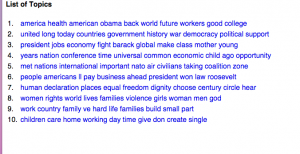
Personally, I was able to use Mallet to create a list of topics, one for Hillary Clinton’s speeches and one for Barrack Obama’s.
Hillary’s:
Obama’s:
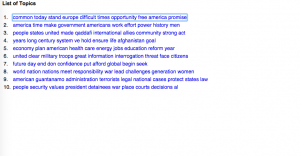
Each of these topic modeling lists allowed me to see what each political figure chooses to talk about and discuss more. These topics are worldly issues that are important to them. Although they are specific to them personally, it is still possible to relate this to a broader scale of all women and men political figures. For example, one issue of topics that Hillary discusses is care for children with working single moms as you can see as the 10th topic which is not an issue that Obama seems to address. This is a pretty predictable result seeing as though, that would definitely be a more personal subject to a female rather than a male running for political office.
For Alchemy, I tested out one of Hillary Clintons speeches to see what kind of sentiments she is using which is shown below. Sentiment is a really important aspect of political speeches because analyzing this can show the magnitude in to which sentiment in their speeches, correlates with there success in winning a political position as well as making a worldly difference.

In Ramsey’s book he says that Mueller’s lists “do not contain anything that one might call, at first glance an astonishing result.” As what some may see as mundane, and trivial words, are actually the most significant words in our corpuses allowing us to create greater inferences. For example, when I first started analyzing my corpus I was able to take words as simple as “men” and “women” to illuminate the difference in the way that men and women view their gender differences. In my further analysis, I could also use Alchemy to see the sentiment in which the words men and women are used to further my knowledge on the subject.
Ramsey also states that “As with Mueller’s lists, one is behooved to go further by examining the language from which these results are drawn.” Moreover, I have come to realize that it is not just the vocabulary in itself that is important in sentiment analysis as well as topic modeling, but the context in which they are placed. This is a really important to take into consideration because as I saw myself when I was doing the exercise on the Gettysburg Address, the words surrounding a topical word can be just as important as the word itself. Moreover, using topic modeling and sentiment analysis is only further my knowledge and inferences on my corpus, and I can’t wait to explore all that is left to discover with these digital platforms!
One reply on “Topic Modeling and Sentiment Analysis”
Nice work, Allie!!